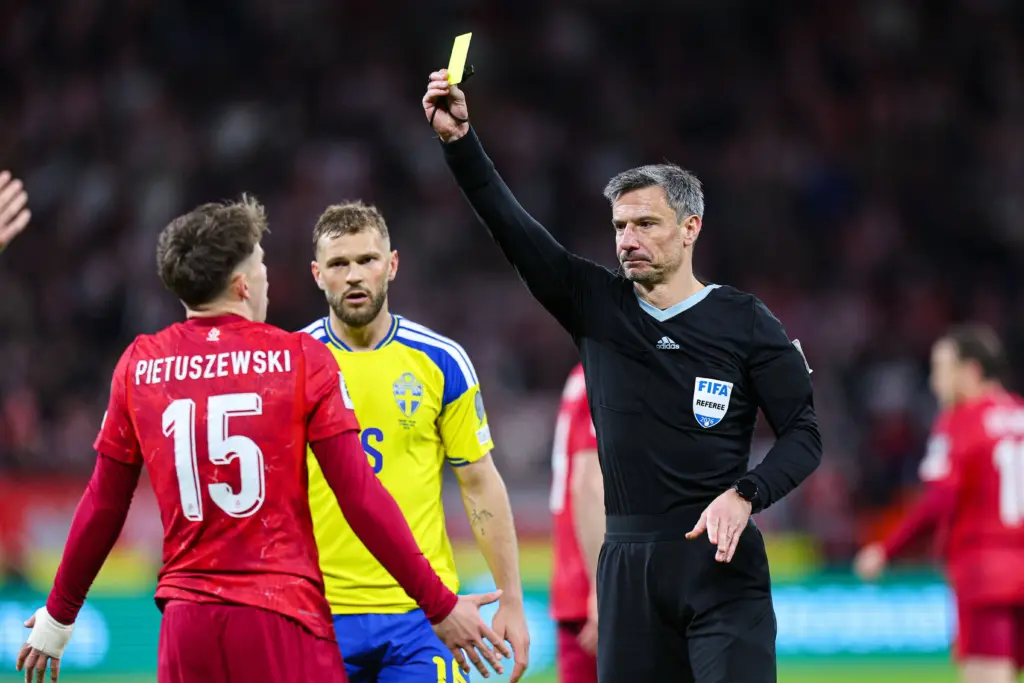
Football and rules usually go hand in hand, which is why the World Cup rule changes regarding yellow cards will add a new complexion and dynamic to the game.
Football is by far the world’s most popular sport, and one of the biggest reasons for that is the simplicity of its rules.
The FIFA World Cup is the flagship competition of the beautiful game, worldwide, regardless of how much others try to claim that mantle for themselves.
However, the 2026 edition of the global mega tournament is truly not making things simple for players or fans.
Expanding the World Cup to 48 teams makes the group stage less important and indeed less simple, as not all groups will have the same number of sides advancing to the knockout stages, for example. Yet, not all World Cup rule changes are bad.
World Cup Rule Changes: The Positive Impact Of Fewer Yellow Card Suspensions
One of the major positive 2026 World Cup rule changes is that the number of yellow card suspensions should go down significantly, because there will be a “yellow card amnesty” after the group stage, as well as after the quarter-finals (as had been the case previously).
With the expansion of the tournament to 48 teams, the Round of 32 has been added as an extra round in the knockout stages of the World Cup.
A player will still be suspended for two yellow cards accumulated during the tournament, as a general rule; however, the amnesty means that each player’s disciplinary record will be wiped clean twice in the tournament.
World Cup Rule Changes: Possible Ways How Players Can Miss Games For Yellow Card Accumulation
Only suspensions will carry over into the next stage; single cards disappear. That means that players can only be suspended for cards sustained in the first two group matches to miss the third match.
Players will then miss the Round of 32 by getting a caution in two out of the three group games. A suspension will then carry over into the quarter-finals with cards in the Round of 32 and the round of 16, or from the semi-finals with cautions in the quarter-finals and either the Round of 32 or the Round of 16.
YOU MAY ALSO LIKE: UEFA Champions League Semi-Final: Predicting What To Expect In The Thrilling PSG vs Bayern Munich Clash
World Cup Rule Changes: FIFA Have Changed The Yellow Card Suspension Rules Before
World football’s governing body had already relaxed its rules regarding yellow card suspensions after the 2002 World Cup.
During that tournament, Germany’s star midfielder Michael Ballack had to miss the final against Brazil due to having been cautioned in both the Round of 16 and the semi-finals.
Then, football authorities realised that World Cup rule changes had to take place, so that a player never again had to miss the final for such a relatively trivial reason, such as yellow card accumulation.
Indeed, fans and commentators alike often criticise FIFA for ridiculous rule changes, and most of the time, those criticisms are very much warranted.
Even so, as much as it may hurt to have to admit it, the world governing body of football made the right change here.
Fewer yellow card suspensions at the greatest tournament of them all is a welcome change. Most of us may not agree that there should be 48 teams competing at the World Cup, but if that has to happen, at least limit suspensions, and this will be a welcome World Cup rule change.
Main Photo
Credit: IMAGO / Newspix
Recording Date: 31.03.2026
PakarPBN
A Private Blog Network (PBN) is a collection of websites that are controlled by a single individual or organization and used primarily to build backlinks to a “money site” in order to influence its ranking in search engines such as Google. The core idea behind a PBN is based on the importance of backlinks in Google’s ranking algorithm. Since Google views backlinks as signals of authority and trust, some website owners attempt to artificially create these signals through a controlled network of sites.
In a typical PBN setup, the owner acquires expired or aged domains that already have existing authority, backlinks, and history. These domains are rebuilt with new content and hosted separately, often using different IP addresses, hosting providers, themes, and ownership details to make them appear unrelated. Within the content published on these sites, links are strategically placed that point to the main website the owner wants to rank higher. By doing this, the owner attempts to pass link equity (also known as “link juice”) from the PBN sites to the target website.
The purpose of a PBN is to give the impression that the target website is naturally earning links from multiple independent sources. If done effectively, this can temporarily improve keyword rankings, increase organic visibility, and drive more traffic from search results.